
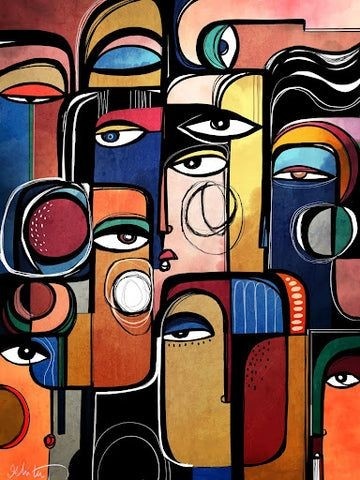
Symphony: harmony in music or colour, a harmonious combination of elements…
We have the capacity to inhabit as many versions of ourselves as we can create.
For a long time now, I have been plagued with the constant meditation on the various forms we demonstrate living and happiness as humans. How often our perceptions are reshaped by new encounters.
Consequently, we are a product of several edited thoughts, depending on the angle of observation. More important is the fact that we are not a single thing. Our individuality is a bundle of dynamism that is ever in a state of metamorphosis.

The concept of morality is so subjective that a thief is also a good person. The perception of a thief to family is different from the perception of a thief to the victim. Simultaneously, a person of faith may still inhabit doubts and a happy person can also have chronic melancholic episodes.
The most interesting aspect of this dynamism is how we can hold entirely opposing ideas in the same body and mind. Wanting commitments and the safety of security while, desirous of variety and need for exploration. Being a hero in one context and a villain in another. A loving mother but a selfish daughter. The multiple version of ourselves we invent depending on how we strive to be perceived. The dichotomy between our private and public image.
I have questions though, in all these distinctions are we separate versions of ourselves or the same version split for different circumstances? Is the distinction absolutely exclusive or mutually inclusive? or what does it matter anyways?
Is it that we are the sum total of our actions or inactions? or strictly that we are who we are perceived to be or who we think people perceive us to be but is in fact, how we want to be perceived that we make assumptions about?
What percentage of traits qualify us for an identity?, For example, when does a thief become one? At the first instance of stealing or the 50th? Is the thief not already in grooming at the moment of thought? Is the thief unaware of the intent to steal at the time of scheming? At what moment does a thief conjugate such personality? Is the criminality really from the consensus of the thoughts and actions?
This question is interesting because in another context, the same thief who denied another of his/ her property will pay to acquire certain properties. The nuances of an unfaithful partner in the context of the other party. It seems that people do not necessarily show up as themselves rather as a context of their environment, expectations, and projections.
We often agree that we are different people all over the world, we acknowledge those differences through culture, religion, education, and material acquisition. Yet, we have certain expectations of people closest to us. Why?
In the end, I think as we encounter people, we must make room for them to show up as every facet of themselves. Understanding that we can be many things all at once.
The polymathic expression of humanity is one that must be accepted with awe not judgment.

 Connoisseur of Memories